
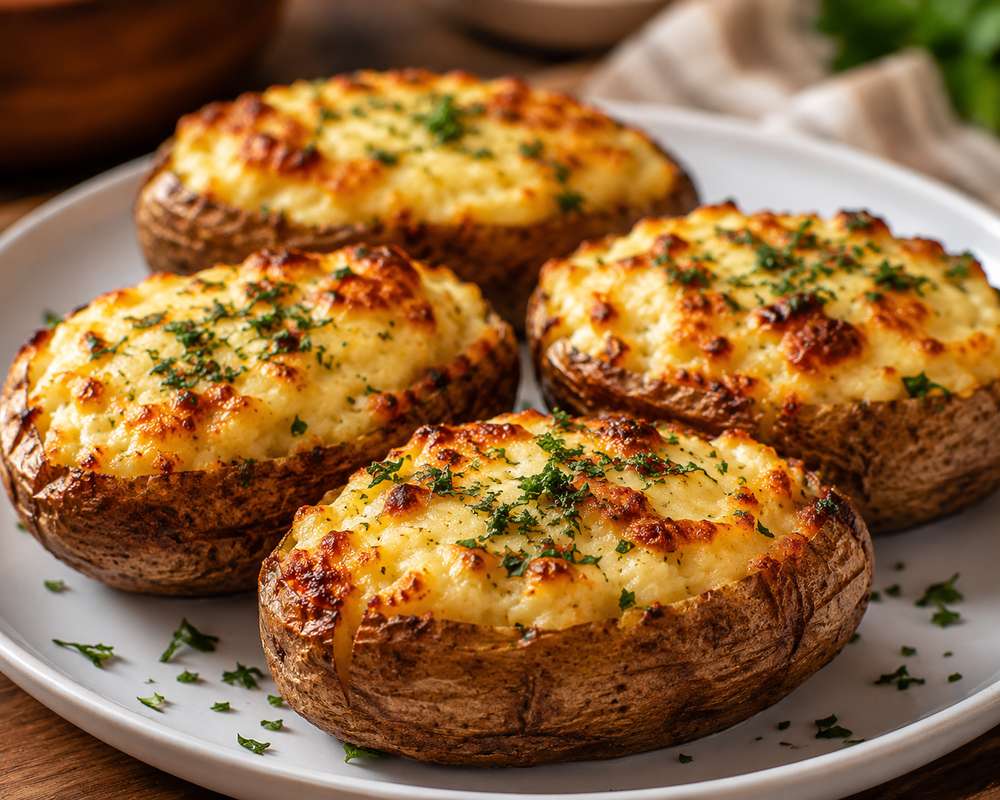
These Cheesy Garlic Stuffed Baked Potatoes begin with oven-baked russet potatoes and end with crisp shells packed with a roasted-garlic, brown-butter potato filling. Cheddar gives the filling a bold savory flavor, mozzarella adds a soft melt, and a small amount of Parmesan deepens the cheesy finish.
The potatoes are baked twice for two different reasons. The first bake softens the centers and strengthens the skins. After the potato flesh is removed, the empty shells return to the oven briefly so their cut surfaces dry and become firmer. They are then refilled, covered with cheese and buttery herb crumbs, and baked again until hot and golden.
Roasting the garlic changes its character completely. Instead of tasting sharp or raw, it becomes soft, lightly sweet, and easy to mash into the warm potato. Mixing it with gently browned butter spreads that garlic flavor throughout the filling without requiring a heavy sauce.
These potatoes can be served as a hearty side dish, a meat-free lunch, or a comforting dinner with salad and vegetables. They also work well for gatherings because the potatoes can be filled ahead of time and baked shortly before serving.
Ingredients
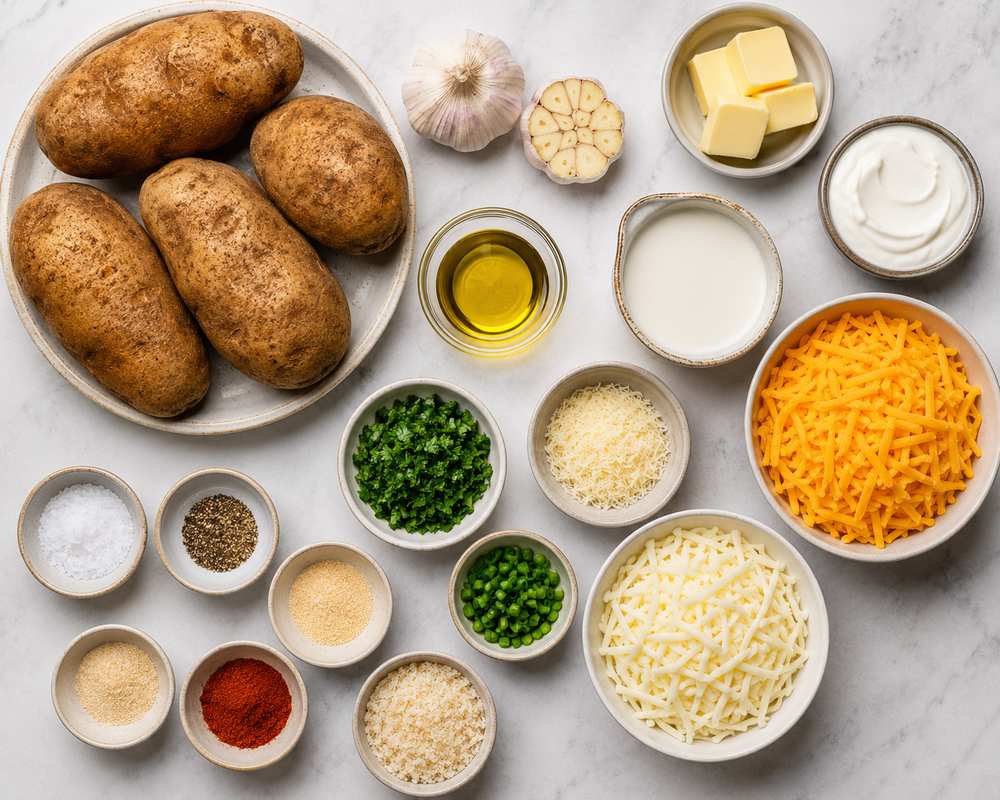
For the Potatoes
- 4 large russet potatoes, similar in size
- 2 teaspoons olive oil
- 1 teaspoon coarse salt
- 1/4 teaspoon ground black pepper
For the Roasted Garlic Brown Butter
- 1 small head of garlic
- 1 teaspoon olive oil
- 4 tablespoons unsalted butter
- 1/2 teaspoon dried thyme
- Pinch of salt
For the Creamy Potato Filling
- Cooked potato flesh from the baked potatoes
- Roasted garlic brown butter
- 3 ounces cream cheese, softened
- 1/3 cup sour cream
- 1/3 cup warm whole milk, plus more as needed
- 1 cup freshly shredded sharp cheddar
- 1/2 cup freshly shredded mozzarella
- 1/4 cup finely grated Parmesan made with vegetarian or microbial enzymes
- 2 tablespoons finely chopped chives
- 1 tablespoon chopped fresh parsley
- 3/4 teaspoon salt, or to taste
- 1/2 teaspoon garlic powder
- 1/4 teaspoon mustard powder
- 1/4 teaspoon onion powder
- 1/4 teaspoon ground black pepper
- Pinch of smoked paprika
For the Golden Topping
- 1/2 cup freshly shredded cheddar
- 1/4 cup freshly shredded mozzarella
- 2 tablespoons panko breadcrumbs
- 1 tablespoon finely grated Parmesan made with vegetarian or microbial enzymes
- 1 tablespoon melted butter
- 1 teaspoon chopped fresh parsley
- Pinch of smoked paprika
For Serving
- Chopped chives or parsley
- Sour cream, optional
- Freshly ground black pepper
- Red pepper flakes, optional
How to Make Cheesy Garlic Stuffed Baked Potatoes
Step 1: Prepare the Potatoes
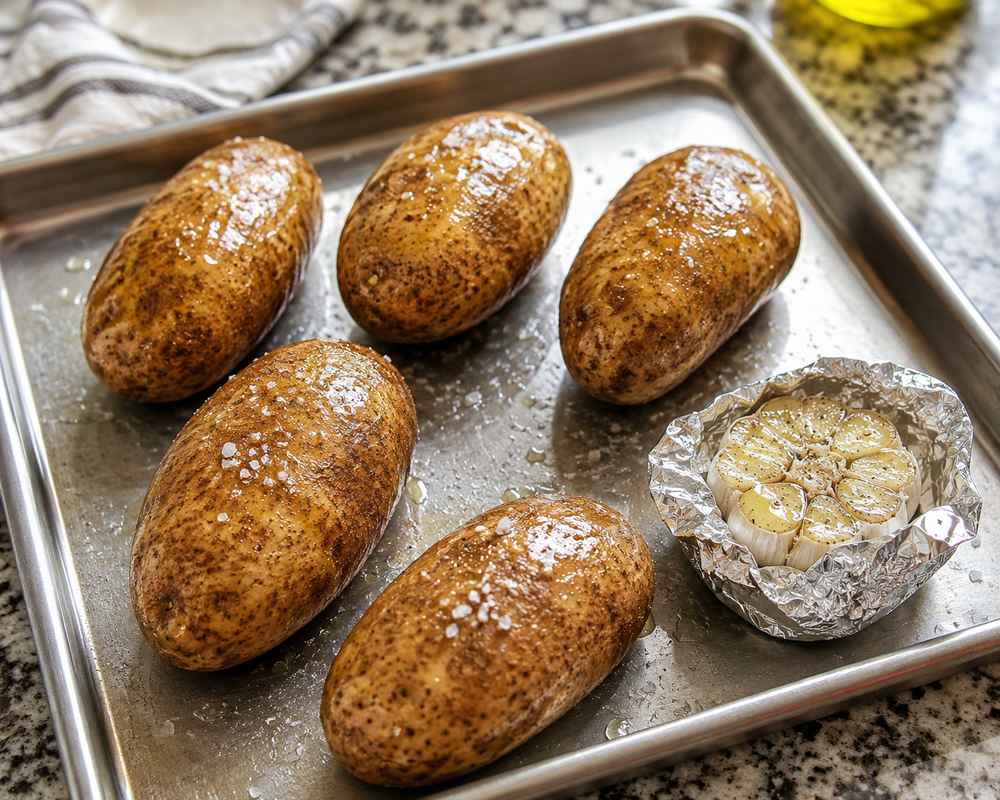
Preheat the oven to 425°F or 220°C.
Wash the potatoes thoroughly, scrubbing away any soil from the skins.
Dry them completely with a clean kitchen towel. Leaving water on the outside can interfere with browning and make the skins softer.
Pierce each potato five or six times with a fork. These small openings give steam a way to escape while the potatoes bake.
Rub the potatoes with olive oil.
Season the outside with coarse salt and black pepper, turning each potato so the seasoning reaches all sides.
Place the potatoes on a rimmed baking sheet.
Do not wrap them in foil. Direct oven heat helps develop firmer, more flavorful skins.
Step 2: Prepare the Garlic for Roasting
Slice approximately 1/4 inch from the top of the garlic head, exposing the upper part of the cloves.
Place the garlic on a small square of foil.
Drizzle 1 teaspoon of olive oil over the exposed cloves.
Wrap the foil around the garlic, leaving a little room inside for steam to circulate.
Place the wrapped garlic on the baking sheet beside the potatoes.
The garlic will usually finish before the potatoes, so it should be checked separately during baking.
Step 3: Complete the First Bake
Bake the potatoes for approximately 55 to 70 minutes.
Cooking time depends on the size and shape of the potatoes.
Check the garlic after approximately 35 to 45 minutes. It is ready when the cloves feel very soft when pressed gently through the foil.
Remove the garlic from the oven and leave it wrapped while it cools.
Continue baking the potatoes until a thin knife slides easily into their centers without resistance.
The skins should feel dry and slightly crisp, while the inside should be completely soft.
Do not remove the potatoes while their centers are still firm. Undercooked potato is difficult to mash and can leave hard pieces in the filling.
Step 4: Make the Roasted Garlic Brown Butter
While the baked potatoes cool slightly, place the butter in a small saucepan over medium-low heat.
Allow it to melt.
Continue cooking gently, swirling the saucepan occasionally.
The butter will foam, and small milk solids will begin settling on the bottom.
Once those solids turn light golden and the butter smells slightly nutty, remove the saucepan from the heat.
Do not wait until the solids become dark brown, as they can turn bitter quickly.
Unwrap the roasted garlic.
Squeeze the soft cloves into the warm brown butter.
Add the thyme and a pinch of salt.
Mash the garlic into the butter with a fork or small whisk until it becomes mostly smooth.
Set the mixture aside.
Step 5: Cut and Scoop the Potatoes
Allow the potatoes to cool for approximately 10 minutes.
They should still be warm, but safe enough to handle carefully.
Reduce the oven temperature to 400°F or 200°C.
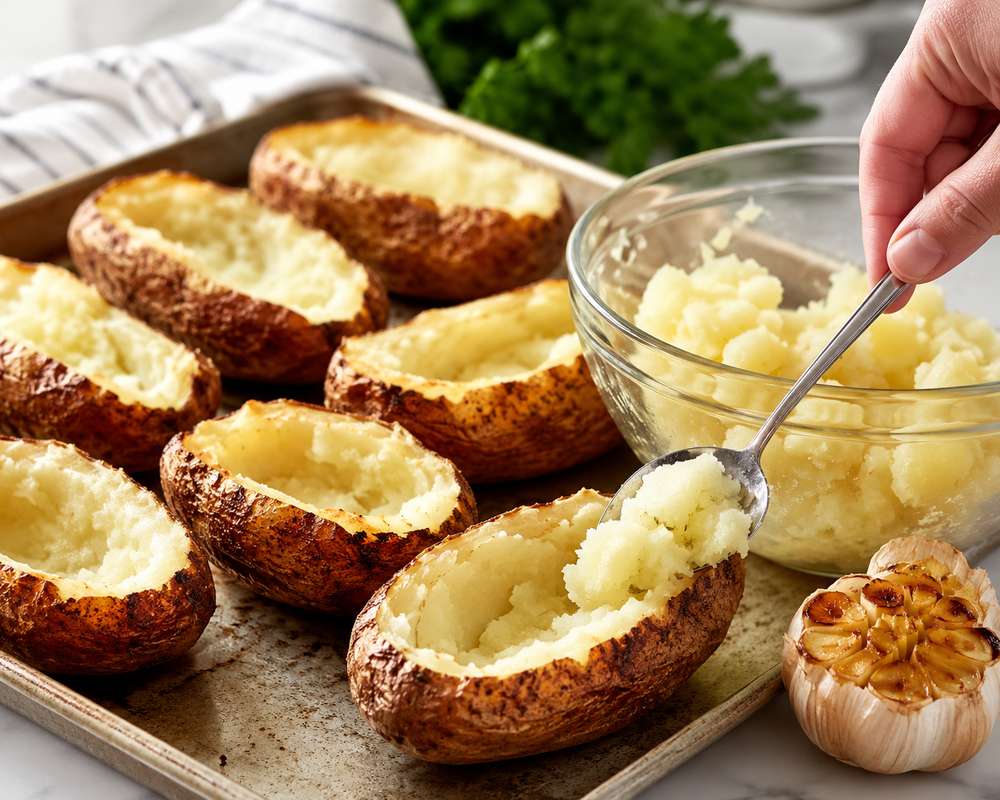
Cut each potato in half lengthwise.
Use a spoon to transfer the soft center into a large mixing bowl.
Leave approximately 1/4 inch of potato attached to the skin.
This thin layer provides structure and reduces the chance of the shells collapsing or tearing.
Work slowly around the edges and avoid pushing the spoon through the bottom.
Place the empty shells cut-side up on the baking sheet.
Step 6: Firm Up the Empty Shells
Brush the inside of each shell with a very small amount of the roasted garlic brown butter.
Return the empty shells to the oven for approximately 7 to 8 minutes.
This short bake removes surface moisture and firms up the inside.
It also gives the filled potatoes a better contrast between the shell and the soft center.
Remove the shells from the oven and keep them on the baking sheet.
Step 7: Make the Cheese and Garlic Filling
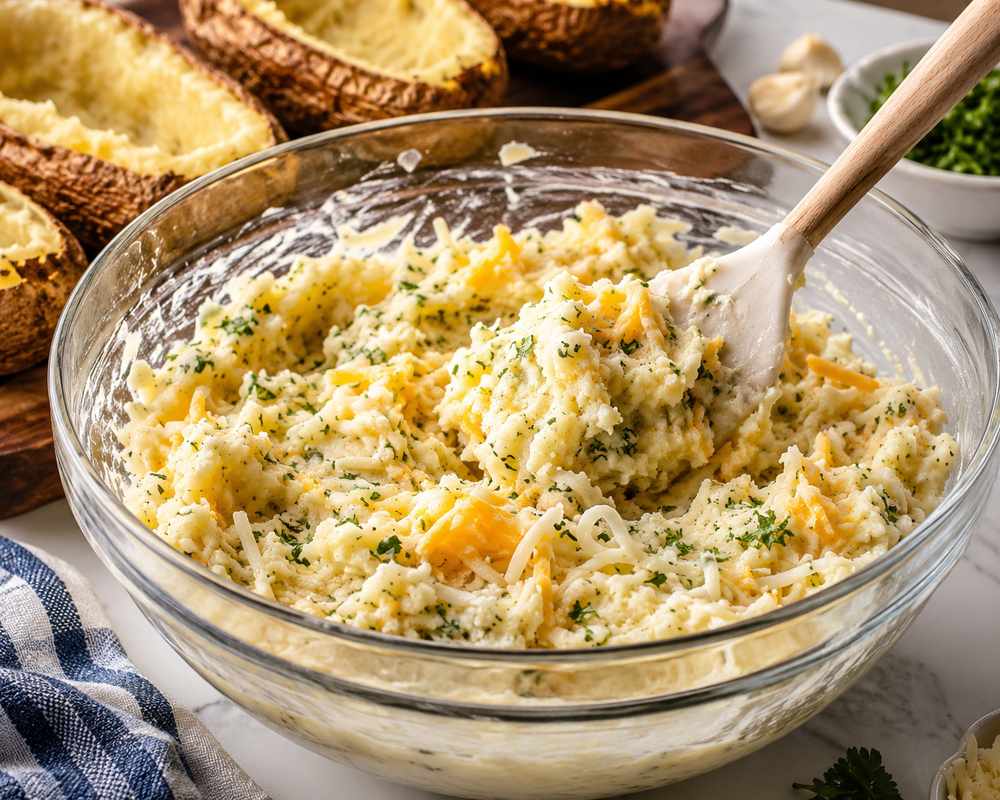
Add the remaining roasted garlic brown butter to the warm potato flesh.
Add the softened cream cheese.
Mash gently until the larger potato pieces have broken down and the cream cheese is distributed.
Add:
- Sour cream
- Warm milk
- Cheddar
- Mozzarella
- Parmesan
- Chives
- Parsley
- Salt
- Garlic powder
- Mustard powder
- Onion powder
- Black pepper
- Smoked paprika
Fold everything together with a sturdy spoon or flexible spatula.
Do not whip the potato with a high-speed mixer.
Strong or prolonged mixing releases additional starch and can turn the filling sticky.
The filling should be creamy but not runny. It should hold a soft mound on the spoon.
When it feels too firm, add warm milk 1 tablespoon at a time.
When it feels too loose, allow it to sit for a few minutes before making adjustments. The cheese and potato will thicken the mixture slightly as it rests.
Taste the filling.
Potatoes absorb seasoning readily, so add another small pinch of salt or pepper when needed.
Step 8: Refill the Potato Shells
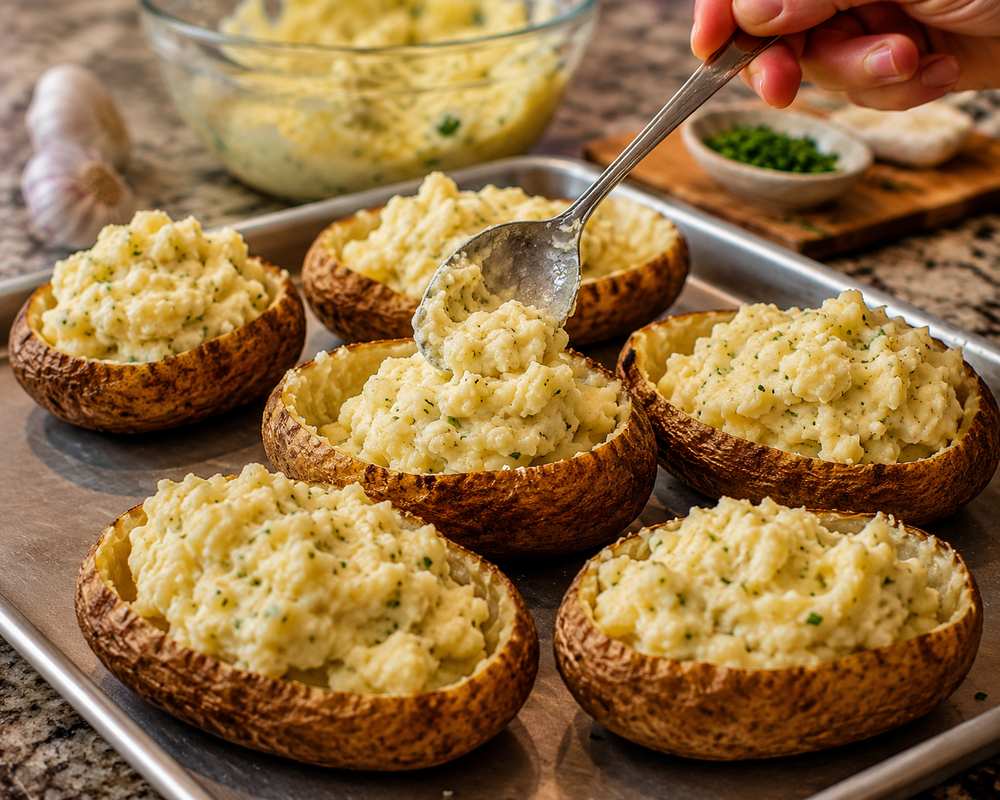
Divide the filling evenly between the eight shells.
Spoon it in loosely rather than pressing it down.
Build the filling slightly higher in the center of each shell.
Use the back of a spoon to create small peaks and uneven ridges across the surface.
These raised areas catch more direct heat and develop attractive golden spots during the second bake.
Arrange the filled potatoes with a little space between them.
Step 9: Add the Golden Cheese Topping
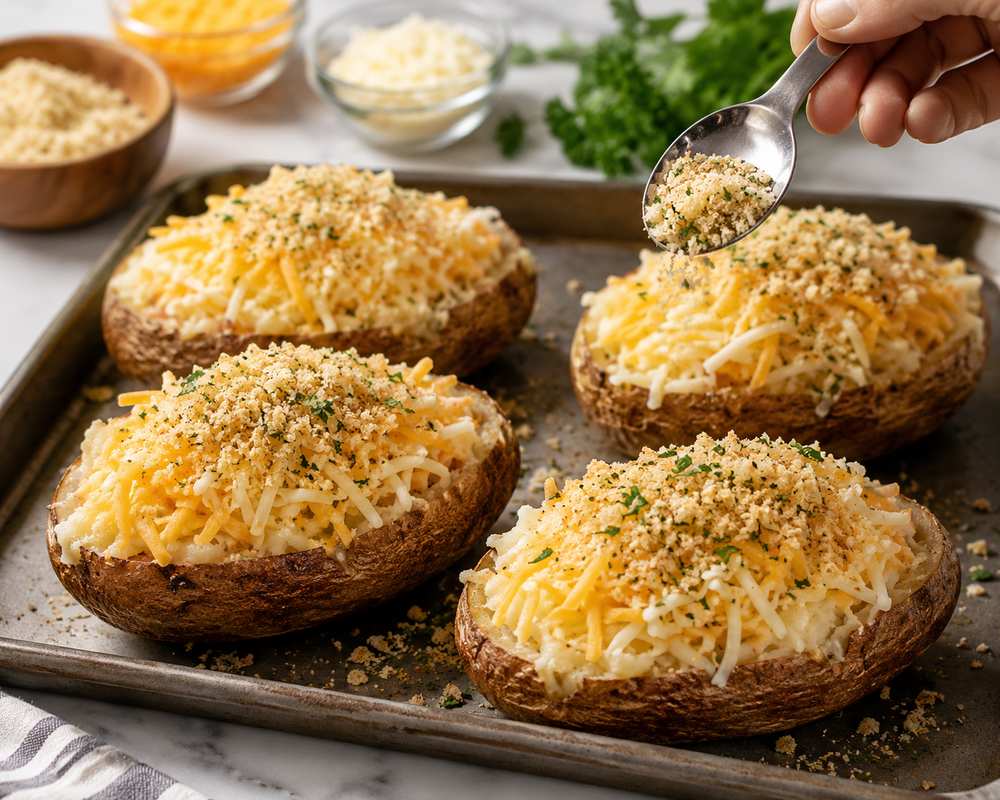
In a small bowl, combine:
- Cheddar
- Mozzarella
- Panko
- Parmesan
- Melted butter
- Parsley
- Smoked paprika
Toss until the breadcrumbs and cheeses are lightly coated with butter.
Scatter the topping over each filled potato.
Do not compress it into a solid layer.
A loose topping allows heat to reach more of the surface and creates better browning.
Keep any loose cheese on top of the filling rather than letting large amounts fall onto the baking sheet.
Step 10: Complete the Second Bake
Bake the filled potatoes at 400°F or 200°C for approximately 15 to 18 minutes.
They are ready when the centers are hot and the cheese is fully melted.
For stronger browning, switch the oven to broil during the final 1 to 2 minutes.
Remain beside the oven while broiling.
The panko and cheese can darken quickly.
Remove the potatoes when the topping has golden patches and bubbling edges.
Step 11: Rest and Garnish
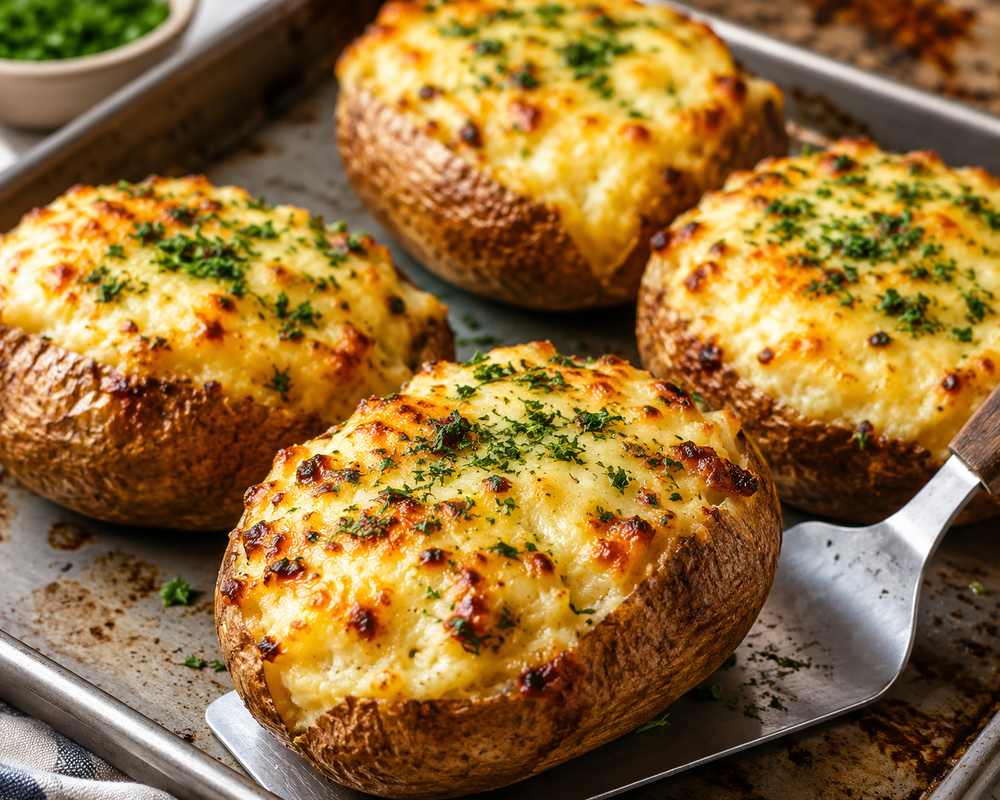
Let the stuffed potatoes rest for approximately 5 minutes before serving.
This brief pause allows the filling to settle and makes the shells easier to lift from the baking sheet.
Finish with chopped chives, parsley, black pepper, or a small pinch of red pepper flakes.
Serve warm with sour cream on the side.
Tips for the Best Stuffed Baked Potatoes
Choose Similar-Sized Potatoes
Potatoes that are close in size will finish baking at roughly the same time.
Very different sizes may leave you with one potato overcooked while another remains firm.
Use Russet Potatoes
Russets have a high-starch interior that becomes light when baked.
Their thicker skins also handle scooping and refilling better than many thin-skinned varieties.
Dry the Potatoes Thoroughly
A dry surface helps the oil and salt cling to the skin.
It also encourages better browning.
Bake Until Completely Soft
The first bake determines the texture of the filling.
A fully tender potato can be mashed gently, while an undercooked one requires more mixing and still produces lumps.
Work with Warm Potato Flesh
Warm potato blends more easily with butter and softened cream cheese.
Cold potato can require additional mixing, which may affect the final texture.
Warm the Milk
Cold milk can cool the filling quickly.
Slightly warm milk blends more smoothly and allows you to judge the consistency more accurately.
Do Not Overmix
Mash first, then fold.
Stop once the filling looks evenly combined.
Grate the Cheese Freshly
Freshly grated cheese usually melts more smoothly and blends into the filling more evenly than heavily coated pre-shredded cheese.
Season Before Refilling
Taste the mixture while it is still in the bowl.
Correcting the seasoning becomes more difficult after the potatoes have been topped and baked.
Crisp the Shells Before Filling
The short empty-shell bake is worth the extra few minutes.
It creates a stronger shell and reduces sogginess around the cut surface.
Watch the Broiler Closely
The final broil is optional.
Once activated, check the potatoes every 20 to 30 seconds rather than relying on a fixed time.
Best Ways to Serve Cheesy Garlic Stuffed Potatoes
These potatoes can be served as a substantial side dish or a simple main course.
Serve them with:
- Roasted chicken
- Baked or grilled fish
- Steamed broccoli
- Roasted asparagus
- Green beans
- Garlic mushrooms
- Roasted carrots
- Tomato soup
- Vegetable soup
- Cucumber salad
- Garden salad
- Grilled corn
For a lighter dinner, serve two potato halves with a large green salad.
For a more traditional meal, serve one half alongside roasted chicken and vegetables.
Recipe Variations
Broccoli and Cheddar
Fold 1 cup of finely chopped steamed broccoli into the filling.
Drain and cool the broccoli first so it does not introduce excess water.
Spinach and Garlic
Cook chopped spinach until wilted.
Squeeze out as much moisture as possible before folding it into the potato mixture.
Caramelized Onion
Add 1/3 cup finely chopped caramelized onions.
Their sweetness works especially well with roasted garlic and sharp cheddar.
Mushroom and Herb
Cook finely chopped mushrooms until their moisture evaporates and their edges begin browning.
Add them with extra parsley or thyme.
Spicy Cheese
Mix finely chopped jalapeño into the filling and add red pepper flakes to the topping.
Extra-Crispy Topping
Increase the panko to 1/4 cup and add another teaspoon of melted butter.
Lighter Filling
Replace the sour cream with thick plain yogurt.
The filling will be slightly tangier and less rich.
Can You Make Them Ahead?
Yes.
Complete the recipe through the filling stage.
Arrange the stuffed potatoes on a baking sheet or inside a covered container.
Refrigerate without adding the final topping.
Before baking, place the chilled potatoes on a baking sheet and add the cheese-panko mixture.
Bake until the centers are thoroughly hot and the topping is melted.
Cold potatoes may require an additional 5 to 10 minutes in the oven.
For the best shell texture, complete the final bake on the same day they will be served.
How to Store Leftovers
Allow the potatoes to cool, then transfer them to a shallow airtight container.
Refrigerate within two hours of cooking and use within 3 to 4 days, which follows USDA guidance for cooked potatoes and other leftovers.
Store the garnish and sour cream separately.
Keeping the potatoes in one layer prevents the cheese topping from sticking to another potato.
How to Reheat
Oven Method
Preheat the oven to 375°F or 190°C.
Place the potatoes on a baking sheet.
Heat for approximately 15 to 20 minutes, or until hot in the center.
Cover loosely for the first part of reheating when the topping is already deeply browned, then uncover near the end.
Air-Fryer Method
Reheat at 350°F or 175°C for approximately 6 to 10 minutes.
Check early because the breadcrumb topping may brown quickly.
Microwave Method
Place one potato half on a microwave-safe plate.
Heat in short intervals until hot.
This is the fastest method, but the skin and topping will become softer.
For a better result, microwave briefly and finish in an oven or air fryer.
Frequently Asked Questions
Can I use Yukon Gold potatoes?
Yes.
Large Yukon Gold potatoes can be stuffed, but their flesh is naturally denser and creamier than russet potato.
Their skins may also be less sturdy, so scoop them carefully.
Can I use fresh minced garlic instead of roasted garlic?
Yes.
Cook 2 or 3 finely minced garlic cloves in butter over low heat until fragrant.
Do not brown the garlic itself.
Fresh garlic will give the filling a sharper flavor than roasted garlic.
Do I have to brown the butter?
No.
Regular melted butter works.
Brown butter adds a slightly toasted, nutty background flavor, but the potatoes will still be creamy without it.
Can I leave out the cream cheese?
Yes.
Replace it with another 1/4 cup of sour cream and reduce the milk slightly.
Add the milk gradually so the filling does not become loose.
Why did my filling become gummy?
The potato was probably mixed too aggressively or for too long.
Use a hand masher or spoon and stop once the filling is combined.
Why did the shells fall apart?
The shells may break when too much potato is removed or when the skins are very thin.
Leave an even layer of potato inside and handle the shells with a wide spatula.
Can I prepare the potatoes the night before?
Yes.
Fill and refrigerate them covered.
Add the topping before the second bake.
Allow additional baking time because the centers will be cold.
Can I freeze them?
Yes.
Freeze the filled potatoes individually on a tray until firm, then wrap and transfer them to a freezer-safe container.
For the best texture, thaw them in the refrigerator before reheating.
Can I make them without sour cream?
Yes.
Use thick plain yogurt or additional softened cream cheese with a little extra milk.
Can I omit Parmesan?
Yes.
Replace it with extra cheddar or leave it out.
The finished flavor will be slightly milder.
Can I make smaller appetizer potatoes?
Yes.
Use small russet or baby potatoes.
The first baking time will be shorter, and the shells will need more careful scooping.
Leave a Reply